Sizing
How much seat weaving cord do I need for one seat?
Estimate Danish cord, fiber rush, seagrass and Shaker tape for a chair seat from its rail measurements, with worked examples and typical amounts per seat.
Updated
For most chairs the answer is one coil or one kit per seat: a typical dining chair seat takes 1.5 to 2 lb of Danish cord, one 2 lb coil of fiber rush, or two 1 lb coils of seagrass. Shaker tape has its own simple formula. For a bench, a big armchair or a set of chairs, measure the rails and work it out with the method below.
Everything for the job is on the project pages: weave a Danish cord seat and weave a rush, seagrass or tape seat.
Typical amounts per seat
| Material | One ordinary chair seat | How we sell it |
|---|---|---|
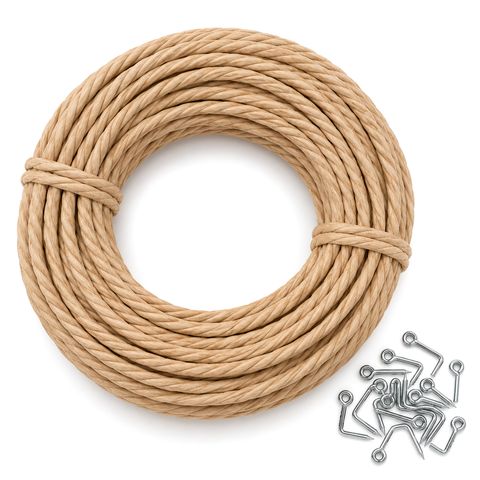
| Danish cord, laced or unlaced | 1.5 to 2 lb for most dining chair seats | 1 lb (about 180 ft) or 2 lb (about 360 ft) coils; kit with a 2 lb coil and 100 L-nails |
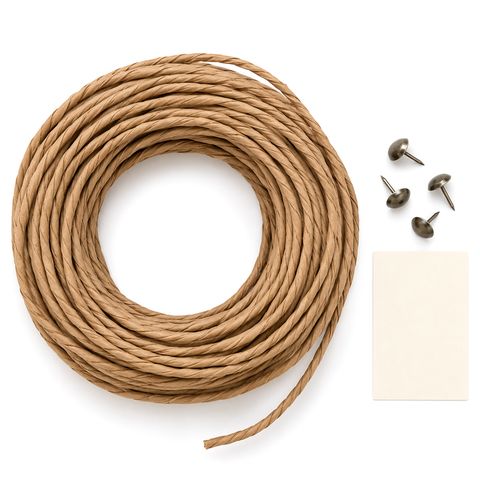
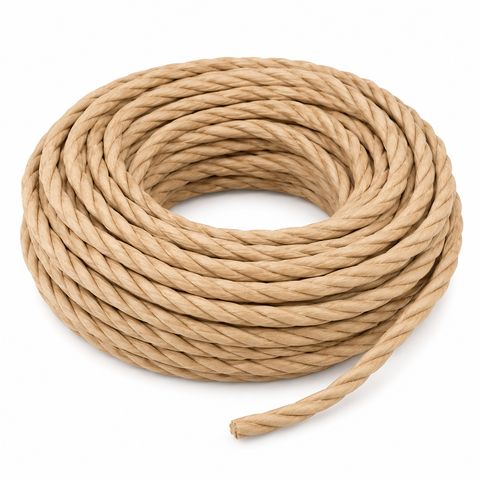
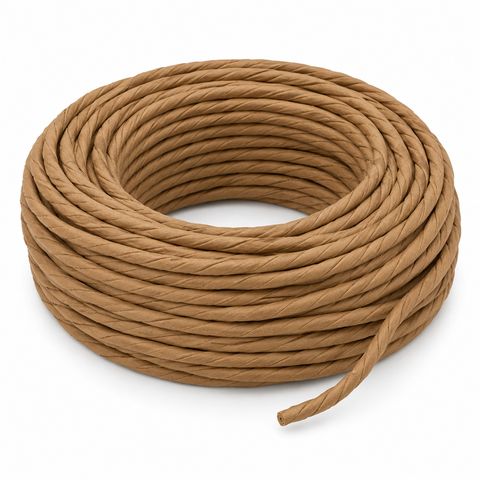
| Fiber rush | One 2 lb coil typically does an average seat | 2 lb coils: 5/32 in about 350 ft, 6/32 in about 280 ft; kit; 10 lb reel of 7/32 in |
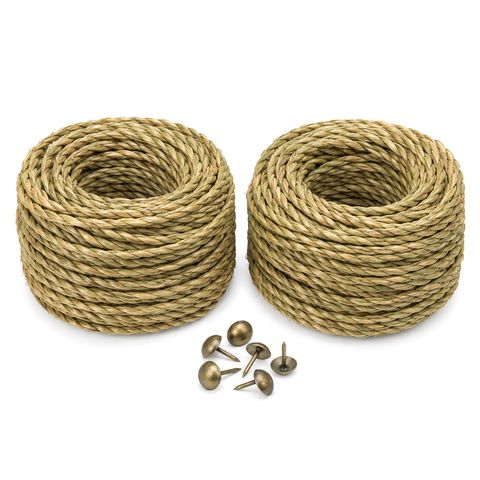
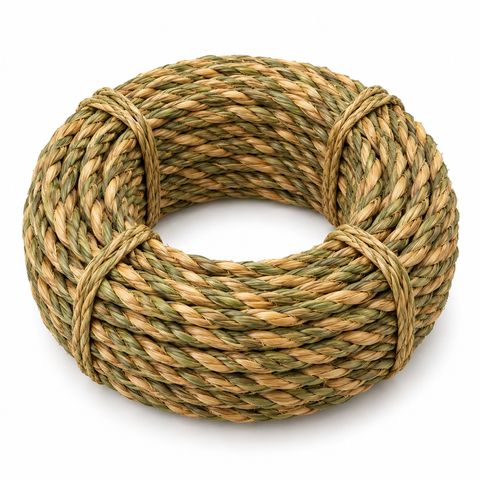
| Seagrass | Two 1 lb coils of the same size | 1 lb coils, #0 to #3; kit with two coils; 2.2 lb coil for full-size seats |
| Shaker tape | Front rail x depth ÷ 9 = yards of 1 in tape | Widths and lengths on the product page |
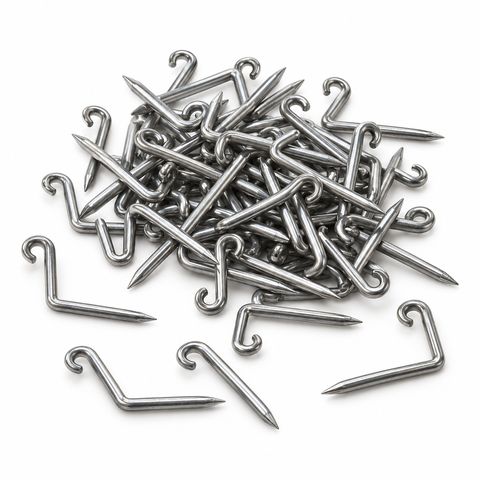
For Danish cord you also need L-nails: a typical chair seat uses 30 to 50.
Step 1: Measure the seat
You need four numbers, in inches:
- Front rail, between the legs.
- Back rail, between the legs.
- Side rail, between the legs. For Shaker tape, measure the depth from the center of the back rail to the center of the front rail instead.
- One rail wrap. Wrap a piece of string once around a rail, snug, and measure the string.
From these, work out two more:
- Seat area = (front rail + back rail) ÷ 2 × side rail
- Total rail length = front rail + back rail + both side rails
Step 2: Wraps per inch
Each wrap around a rail is one cord thickness wide, so the number of wraps in an inch is about 1 divided by the thickness. On an old seat, count the wraps in 1 in along a rail; that count beats any table.
| Cord | Thickness | Wraps per inch, about |
|---|---|---|
| Fiber rush 4/32 in | 1/8 in | 8 |
| Fiber rush 5/32 in | 5/32 in | 6.4 |
| Fiber rush 6/32 in | 3/16 in | 5.3 |
| Fiber rush 7/32 in | 7/32 in | 4.6 |
| Seagrass #0 | 2.25 to 2.75 mm | 9.2 to 11.3 |
| Seagrass #1 | 3 to 3.5 mm | 7.3 to 8.5 |
| Seagrass #2 | 3.5 to 4 mm | 6.4 to 7.3 |
| Seagrass #3 | 4.5 to 5 mm | 5.1 to 5.6 |
For seagrass, the wraps per inch are 25.4 divided by the thickness in mm.
Step 3: Rush-pattern seats (fiber rush and seagrass)
A rush-pattern seat is one layer of cord on top and one underneath, plus the cord wrapped around the rails. So:
Length in inches ≈ wraps per inch × (2 × seat area + total rail length × one rail wrap)
Divide by 12 to get feet.
Example: a ladderback chair in 6/32 in fiber rush
- Front rail 17 in, back rail 13 in, side rails 14 in, one rail wrap 3.5 in.
- Seat area: (17 + 13) ÷ 2 × 14 = 210 sq in. Twice that is 420.
- Total rail length: 17 + 13 + 14 + 14 = 58 in. Times 3.5 = 203.
- 420 + 203 = 623. Times 5.3 wraps per inch = about 3,300 in, or about 275 ft.
A 6/32 in coil is about 280 ft, so one coil only just covers this seat. In 5/32 in rush the same seat takes 623 × 6.4 = about 3,990 in, or 330 ft, against a coil of about 350 ft. That is why a 2 lb coil does an average seat, but not with much to spare.
The formula counts only the cord that ends up in the seat. Knots, tails, packing and the crown over the cardboard stuffing use a little more, so treat the result as the least you need. When the estimate comes close to a coil’s length, as here, order the second coil with the first so the color matches.
Seagrass
Use the same formula with the seagrass wraps per inch. Seagrass is sold by weight, and the length in a pound changes with the thickness and from coil to coil, so we do not quote feet per coil; use the formula to compare seats. Two 1 lb coils of the same size, as in the seagrass seat kit, are meant for an ordinary chair seat or stool top like the ladderback above. If your seat works out half again as long as that example in the same seagrass size, plan on three coils instead of two.
Step 4: Shaker tape
Tape is woven warp and weft, and both cover the top and the bottom of the seat. Suppliers use this formula:
- Measure the front rail between the posts.
- Measure the depth from the center of the back rail to the center of the front rail.
- Multiply the two. Divide by 9 for yards of 1 in tape, or by 5.3 for yards of 5/8 in tape.
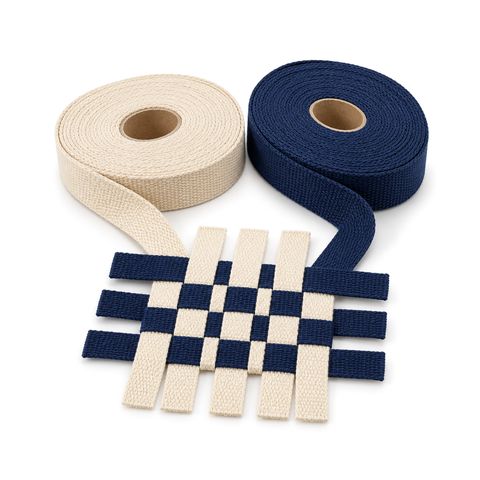
Example: a front rail of 16 in and a depth of 14 in give 16 × 14 = 224. 224 ÷ 9 = about 25 yd (75 ft) of 1 in tape, or 224 ÷ 5.3 = about 42 yd of 5/8 in tape. For a two-color checkerboard, order half in each color: about 12 1/2 yd of each in 1 in tape.
See widths and lengths on the Shaker tape page, and order the tape for a set together.
Step 5: Danish cord
A Danish cord seat is woven warp first, front to back, then weft, side to side. Patterns vary from chair to chair, so the old seat is your best guide. Before you cut it out:
- Count the warp strands that cross the top from front to back, across the middle of the seat. Each one is a loop around the front and back rails.
- Measure one warp loop with string: over the front rail, across the top, around the back rail and back underneath.
- Count the wraps between the warp groups on the front rail. The back rail usually has the same number.
- Count the weft rows that cross the top from side to side, along a side rail, and measure one weft loop around the two side rails.
- Add it up: warp strands × warp loop, plus wraps between groups × one rail wrap, plus weft rows × weft loop. Divide by 12 for feet, and by 180 for pounds, since a 1 lb coil is about 180 ft.
Example: a Danish dining chair
- Front rail 17 in, back rail 15 in, side rails 14 in, one rail wrap 3 in.
- Warp: 32 strands, each loop 31 in: 992 in.
- Wraps between groups: 4 in each of 15 gaps, on both rails: 120 wraps × 3 in = 360 in.
- Weft: 90 rows, each loop 35 in: 3,150 in.
- Total: 4,502 in, about 375 ft, or about 2.1 lb.
A single 2 lb coil would run short here. Order the 2 lb coil or the Danish cord seat kit, plus a 1 lb coil in the same color.
With no old seat, start from the typical 1.5 to 2 lb for a dining chair seat, and add a 1 lb coil for a seat that is clearly bigger. How to weave a Danish cord seat explains how to space the warp.
Two more checks
- Weigh the old seat. Cord is sold by weight: the old cord, weighed on a kitchen scale without the stuffing, is the least the new seat will take.
- Buy a set at once. Natural materials vary in color from coil to coil, so order a set together. The 10 lb reel of 7/32 in fiber rush is for several chairs.
Next steps
To choose a material, see Danish cord vs fiber rush vs seagrass. Weaving is in weaving a fiber rush seat, how to weave a seagrass seat and how to weave a Shaker tape seat. Cord, nails, tacks and kits are on the project pages for Danish cord seats and rush, seagrass and tape seats.
 Fiber Rush
 Twisted Seagrass Cord
 Danish Cord L-Nails