How-to
How to weave a seagrass seat on a stool or chair
Weave a seagrass seat in the rush pattern: pick the size, fill the front corners, wrap each corner, stuff the pockets and tie off underneath, all dry.
Updated
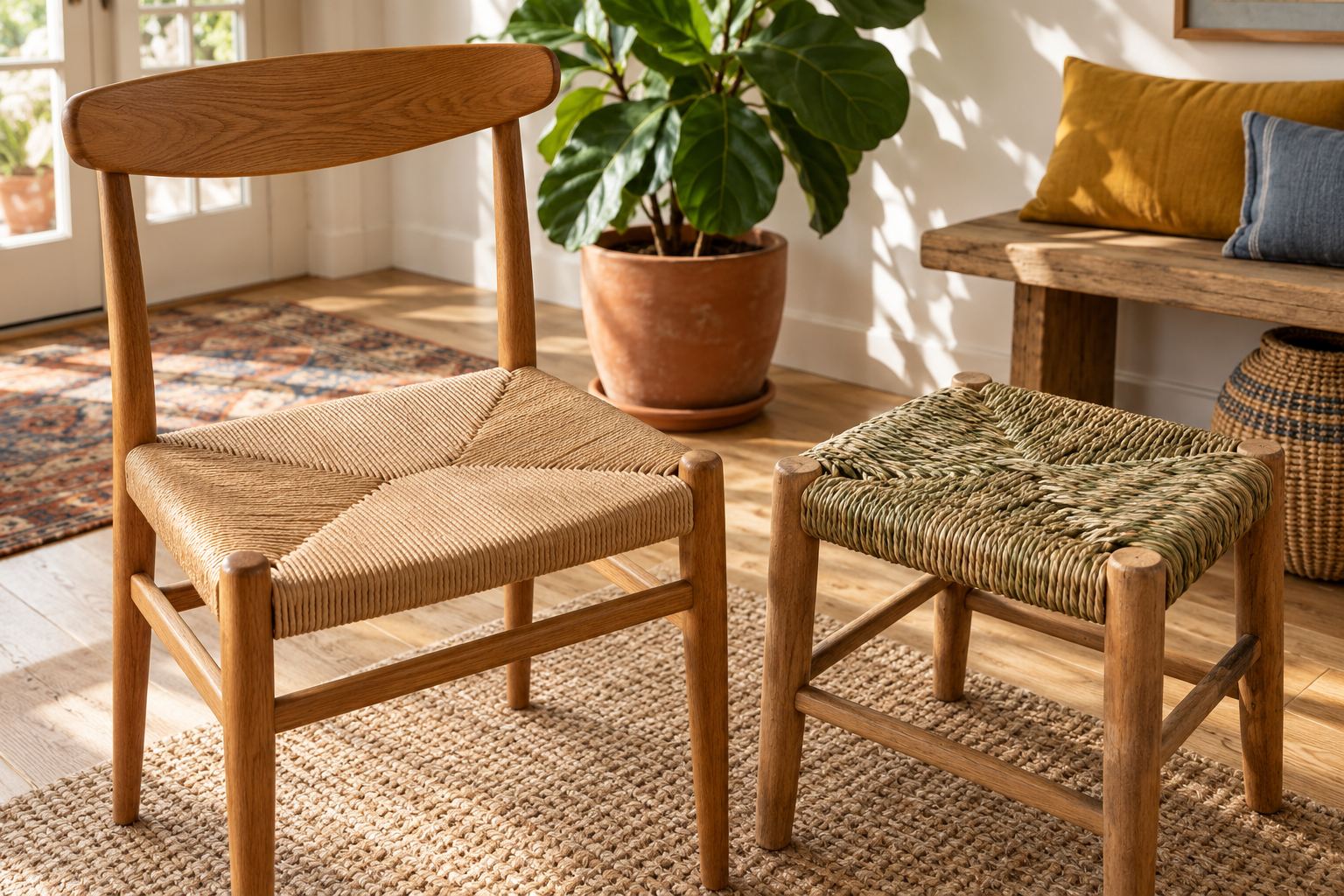
Seagrass is woven around the four rails of a stool or chair in the rush pattern. The cord wraps over and around each rail at the corners in turn, and four triangles grow toward the middle until they meet. Weave it dry, fill the front corners first if the seat is wider at the front, stuff the pockets as they form, and tie off the last strand underneath.
The rush, seagrass and tape seat project page lists the cord, tacks and tools for this kind of seat. Seagrass suits any frame with four rails and posts that rise above them at the corners: footstools, bar stools, cottage chairs and ladderbacks.
What you need
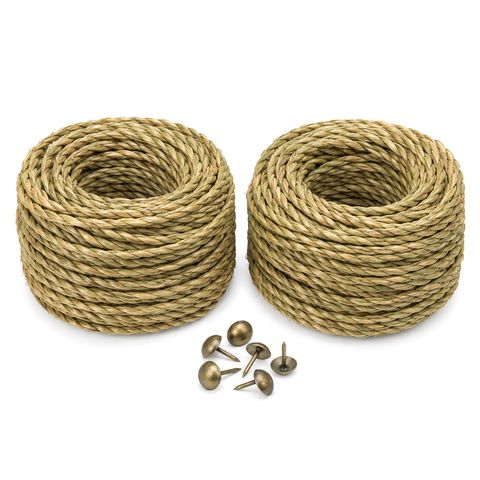
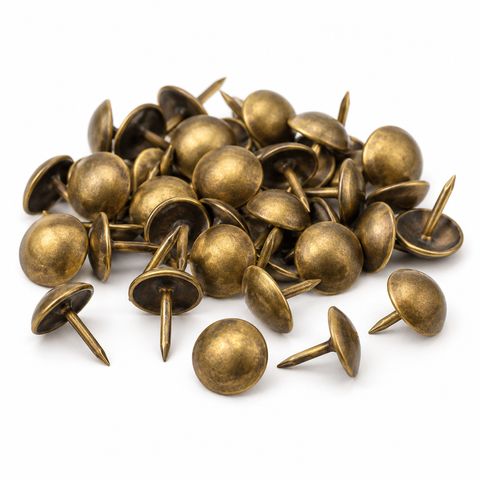
- Seagrass seat kit: two coils of seagrass in the same size and 20 upholstery tacks, for one seat or stool top
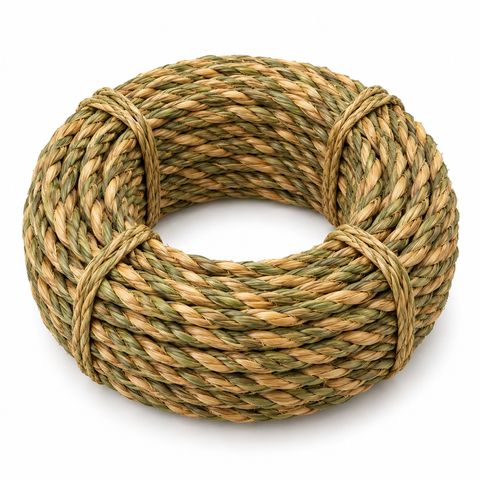
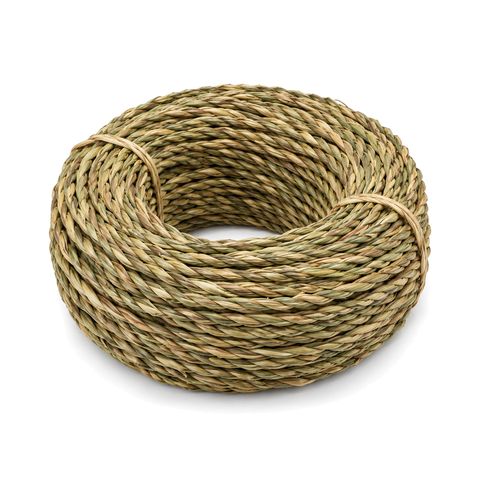
- Or seagrass cord in 1 lb coils, or the 2.2 lb seagrass coil for full-size seats and benches
- Upholstery tacks and a small hammer
- One or two spring clamps
- A carpenter’s square and a pencil
- Sharp scissors
- A blunt wooden stick or paddle, to pack the rows
- Corrugated cardboard, for stuffing
- A spray bottle, for stiff stretches
Choose the size
The size number is the thickness of the cord.
| Size | Thickness | Good for |
|---|---|---|
| #0 | 2.25 to 2.75 mm | Small pieces, baskets and wrapping |
| #1 | 3 to 3.5 mm | Small stools and tight corners; a finer texture |
| #2 | 3.5 to 4 mm | Most stools and chair seats; fewer rounds |
| #3 | 4.5 to 5 mm | Large, rustic seats; a bold texture |
The 2.2 lb coil is about 4 to 5 mm thick. To match an old seat, measure a strand with calipers, or count the wraps in 1 in along a rail and divide 25.4 by that number to get the size in mm.
How much to buy
Two 1 lb coils of the same size do an average seat or stool top, which is what the kit holds. For a large seat or a bench, add a coil or use the 2.2 lb coil. Seagrass varies a little in color from coil to coil, so order everything for one seat, or a set of chairs, at the same time.
Before you start
- Take the coils out of their wrapping and let them air out in the room. New seagrass has a slight grassy smell.
- Weave dry. If a stretch is stiff or kinked, mist it lightly. Do not soak seagrass.
- Glue any loose joints, and sand sharp corners on the rails so they do not cut into the cord.
- Cut a working length of about 25 ft and leave the rest on the coil. Longer lengths tangle and wear as you pull them through.
Step 1: Square up the seat
Many chairs, and some stools, are wider at the front than at the back. The rush pattern needs a square opening, so the extra width at the front is filled first.
- Measure the front rail and the back rail between the posts.
- Subtract and halve the difference. That is how much to fill at each front corner. With a 15 in front rail and a 12 in back rail, the difference is 3 in, so you fill 1 1/2 in at each front corner.
- Hold the square against the back rail at the inside of a back post and mark where it meets the front rail. Repeat on the other side.
If the front and back rails are equal, skip to step 3.
Step 2: Fill the front corners
- Tack the end of a short length to the inside of the left side rail, near the front post.
- Wrap the front left corner: over the front rail, around under it and up through the opening, then over the left rail and around under it.
- Carry the cord straight across to the right side and wrap the front right corner as a mirror image.
- Tack the end to the inside of the right side rail.
- Repeat with the next length, tacking each one just behind the last, until the cord on the front rail reaches your marks.
Push each strand against the one before it. Seagrass is a little slippery and tends to slide out of place, so pinch every corner turn flat as you make it.
Step 3: Wrap the corners
Tack your working length to the inside of the left side rail near the back post, or just behind the last corner-fill tack. Then at every corner:
- Go over the rail in front of you and around under it.
- Come up through the center opening.
- Go over the next rail, crossing over the strand you just laid, and around under it.
- Come up through the center and carry the cord straight across to the next corner.
Go around the seat in the same direction every time. The crossings at the corners build four diagonal lines that run from the corners toward the center.
Joining a new length
Tie the new length to the old one with a square knot under the seat, inside a pocket where the next rounds will cover it. Never leave a knot on top of a rail, where it shows and wears. A spring clamp on the old end holds the tension while you tie.
Step 4: Keep it square and packed
- Pull every wrap snug and keep it there. Seagrass does not shrink tight afterward.
- Pack each round against the last with the stick, so no wood shows between rounds.
- Check the diagonals with the square every few rounds. Seagrass varies a little in thickness along its length, so one corner can creep ahead. Pack the others to catch up.
- Now and then, count the rounds on each rail. They should stay even.
Step 5: Stuff the pockets
As the seat fills, a triangular pocket forms on each side between the top and bottom layers. Stuffing keeps the seat firm and stops the cord from sagging and wearing through at the inside edge of the rails.
Cut triangles of corrugated cardboard a little smaller than each pocket and slide them in from the center, a few layers per side, with their edges kept back from the rails. Offcuts of seagrass work too. Start while the opening is still big enough for your hand, and add more as the pockets grow.
Step 6: Close the center
The shorter pair of rails fills first.
- Square seat. All four triangles meet in the middle at about the same time. Finish with corner wraps.
- Wider than deep. The side rails fill first, and then you can no longer turn corners. Work a figure-eight between the front and back rails: over and under the front rail, up through the center, over and under the back rail, up through the center again, and back to the front, until the gap is closed.
- Deeper than wide. The front and back rails fill first. Work the same figure-eight between the side rails.
Near the end the opening is narrow. A blunt stick or a bent piece of stiff wire helps you pass the cord through.
Step 7: Tie off underneath
- Pack the last rows tight.
- Take the end under the seat and tack it to the inside of a rail.
- Tuck the tail into a pocket, and trim any loose fibers with scissors.
A simpler weave for square stools
On a square stool you can also wrap the cord around two opposite rails in one direction, then weave across it over and under. This is the same warp-and-weft idea as a tape seat; see how to weave a Shaker-style tape seat.
Care
Seagrass is for indoor furniture and covered porches. Keep it out of rain and constant damp, which can bring mildew. Vacuum it with a brush attachment and wipe spots with a barely damp cloth. The green tone mellows with light into a softer, warmer color, so a new seat changes gradually.
For the same pattern in paper, see weaving a fiber rush seat, and to compare the materials, Danish cord vs fiber rush vs seagrass. The full shopping list is on the rush, seagrass and tape seat project page.