How-to
How to reweb a chair seat with elastic webbing
Replace sagging seat webbing: elastic or jute, how far apart to space the straps, how much to stretch them, and fixing them with clips, staples or tacks.
Updated
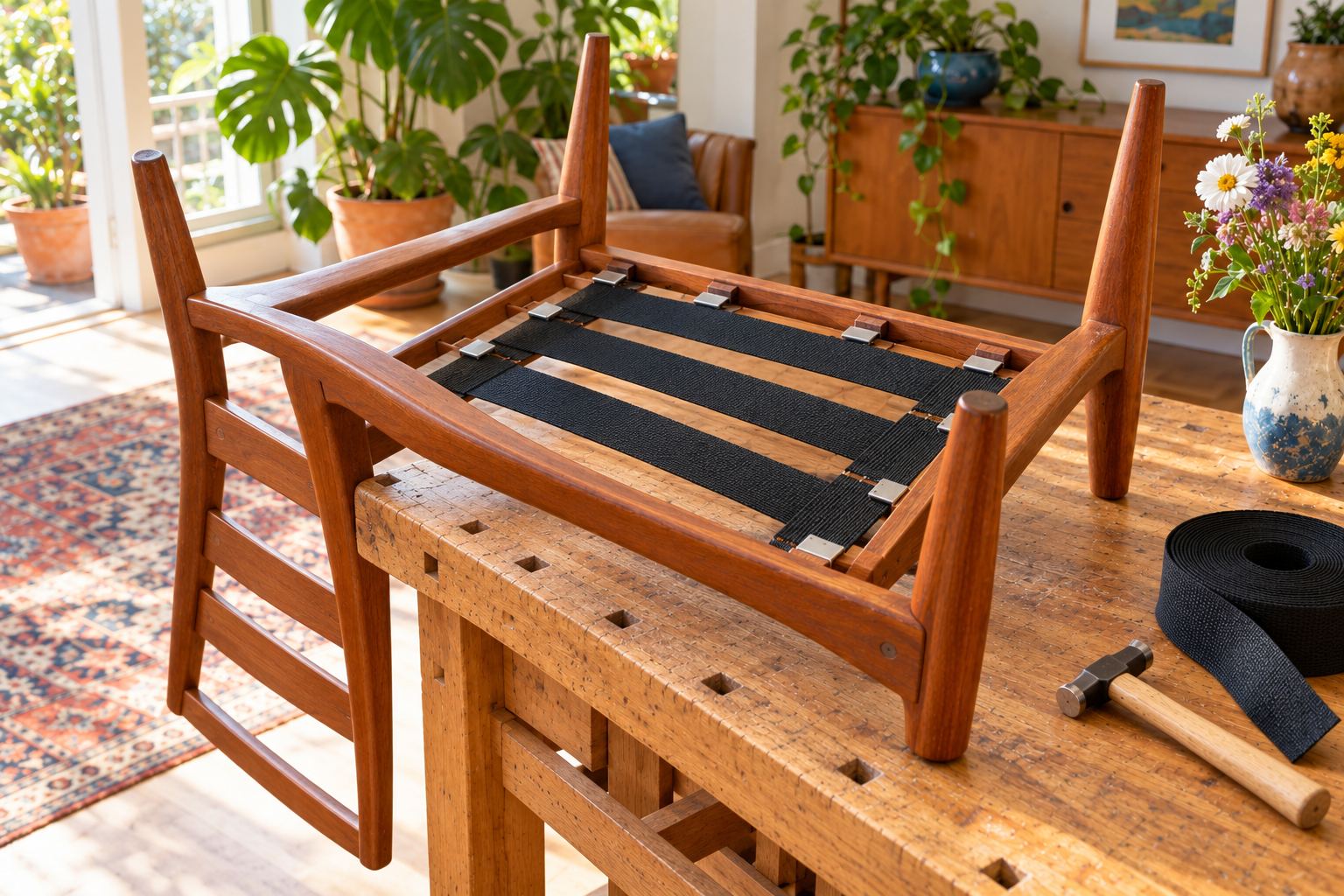
Under the cushion of many mid-century lounge chairs, Danish-style chairs, dining chairs and sofas is a row of rubber straps. That is elastic webbing, and it is what gives the seat its spring. Over the years the rubber dries out and loses its stretch. The straps sag, a few snap, and the cushion sinks toward the floor.
New webbing fixes it. The job is mostly measuring, and keeping every strap the same.
Elastic or jute webbing?
The first rule is to replace like with like. The two kinds of webbing do different jobs.
| Elastic webbing | Jute webbing | |
|---|---|---|
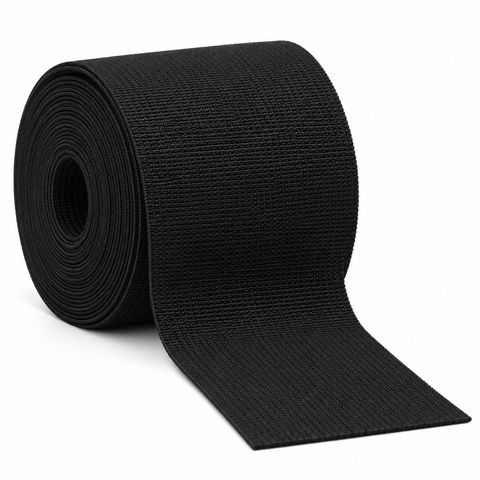
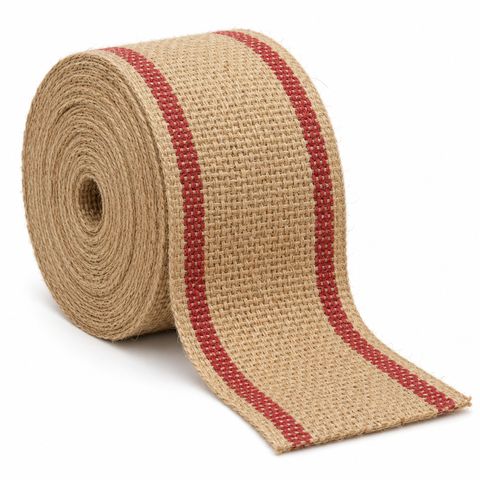
| What it is | Black rubber-latex strap, 2 in wide | Woven natural jute strap, 3.5 in wide |
| How it feels | Stretches and springs back | Firm; does not stretch like elastic |
| Where it goes | Seat support under loose cushions | The traditional base under springs, padding or a drop-in seat |
| How it is fixed | Clips in a groove, or staples or tacks | Tacks or staples while stretched with a webbing stretcher, woven over and under |
If your chair had rubbery straps, use elastic chair webbing. If you are rebuilding an old upholstered seat with springs or a padded drop-in seat, use jute upholstery webbing. Most of this guide is about elastic; jute has its own section near the end.
Study the old webbing first
Turn the chair or the seat frame upside down and photograph it before you take anything off. Note:
- How the straps are fixed. Many mid-century and Danish-style chairs have a metal clip on each strap end, hooked into a slot routed along the rail. Others are stapled or tacked to the top or inside of the rail.
- Which way they run. Many chairs run straps front to back only. Others weave a second set side to side, over and under the first.
- How many there are and how far apart they sit.
Then remove the old straps. Unhook clips from the groove; pry out staples or tacks with a flat screwdriver or a staple lifter. With the frame bare, check for loose joints and cracks, and glue them now. New webbing pulls hard on the rails.
Plan the layout
For 2 in elastic webbing, gaps of about 1 in between straps are common. That puts the straps about 3 in apart, center to center. To count the straps, measure the rail they sit along and divide by 3 in. A rail about 18 in long takes about six straps.
Mark the center of the front and back rails and lay the straps out from the center toward the sides, so the gaps at the two edges match.
How much to stretch elastic webbing
Stretch each strap about 5 to 10 percent. That is enough to stop the seat sagging under a cushion. More is not better: an over-stretched strap is hard to sit on and strains the frame and the fasteners.
An easy way to see the stretch is to mark it:
- Lay a relaxed strap flat and make two pen marks 10 in apart.
- As you fit the strap, pull until the marks sit about 10 1/2 to 11 in apart.
On a clip-and-groove chair, the strap is cut to length before the second clip goes on. As a guide, the cut length is 5 to 10 percent shorter than the distance from groove to groove, measured where the clips sit: 20 in from groove to groove means a strap of about 18 to 19 in. Make one strap first, fit it, and check it before you cut the rest.
To work out how much webbing to buy, multiply the number of straps by the cut length, add a little for each fold or for trimming, and add one spare strap. Six straps at 19 in come to about 9.5 ft for one direction. Our webbing comes in 32, 40 and 160 ft lengths; the long roll suits sofas and sets of chairs.
Fitting elastic webbing with clips
- Cut the strap end square, at a right angle to the edges.
- Slide a new metal webbing clip over the end. Check an old strap to see which way the lip of the clip faces, and match it.
- Squeeze the clip shut in a vise until its teeth bite firmly into the webbing.
- Hook that clip into the groove on one side. Stretch the strap across until your pen marks show the right stretch, mark where it crosses the far groove, and cut it there.
- Fit the second clip the same way round as the first.
- Stretch the strap and hook the second clip into its groove. A helper holding the chair down makes this much easier.
Use this first strap as the pattern for every other strap that runs the same way.
Fitting elastic webbing with staples or tacks
- Clamp the frame to the bench or have a helper hold it. Stretched webbing can lift a light frame.
- Fold the end of the strap back on itself and fix it to the rail with a staggered row of heavy upholstery staples or tacks. Set staples at an angle to the weave so each one catches several rubber strands.
- Pull the strap across until your pen marks show the right stretch, and fix it to the far rail.
- Let go, trim the strap, leaving a short tail, fold the tail back and fix it again.
- If the chair has a second layer, weave it over and under the first, at right angles, and stretch it a little less.
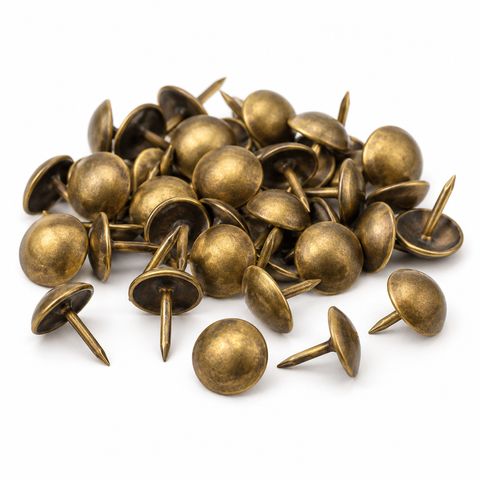
Our antique brass upholstery tacks are decorative: they finish the edges of upholstered, rush and seagrass seats, but are not meant to hold webbing under tension.
Jute webbing for traditional seats
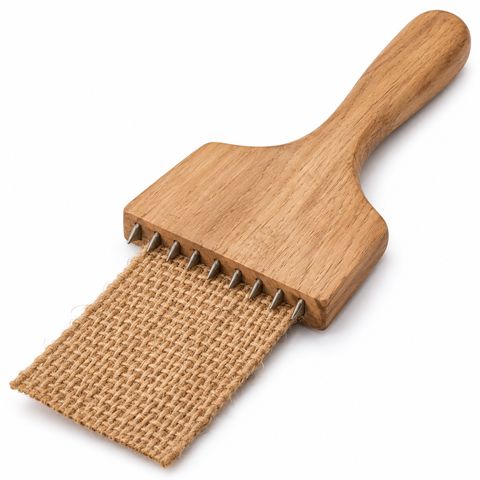
Jute is fitted the same basic way, with two differences: it must be stretched with a webbing stretcher, and it is woven both ways, over and under.
- Mark the centers of the rails and plan the straps close together and evenly spaced.
- Start at the back rail. Fold the end over by about 1 in and fix it with a staggered row of tacks or staples. A staggered row, rather than a straight line, is less likely to split the wood.
- Bring the strap across to the front rail, grip it in the webbing stretcher and lever it tight.
- While it is held, fix a row across the strap. Release the stretcher, cut the strap leaving about 1 to 1 1/2 in, fold the tail back and fix it again.
- Fit all the front-to-back straps, then weave the side-to-side straps over and under them and fix them the same way.
For a quick check, hold a hammer loosely and let its head drop onto the webbing. It should bounce. On a drop-in seat frame, do not pull so hard that the frame bends; set it back in the chair now and then to check that it still fits.
Check the finished seat
Press down across the seat with your hand. Every strap should give about the same amount. If one feels slacker than its neighbors, refit it. Put the cushion back, sit, and look from the side: a level cushion means even webbing.
For more seat parts, from framed cane seats for cantilever chairs to stool tops, see chair seat repair and upholstery. For a woven seat instead of webbing, see weaving a fiber rush seat.
 Webbing Stretcher for Jute Upholstery Webbing