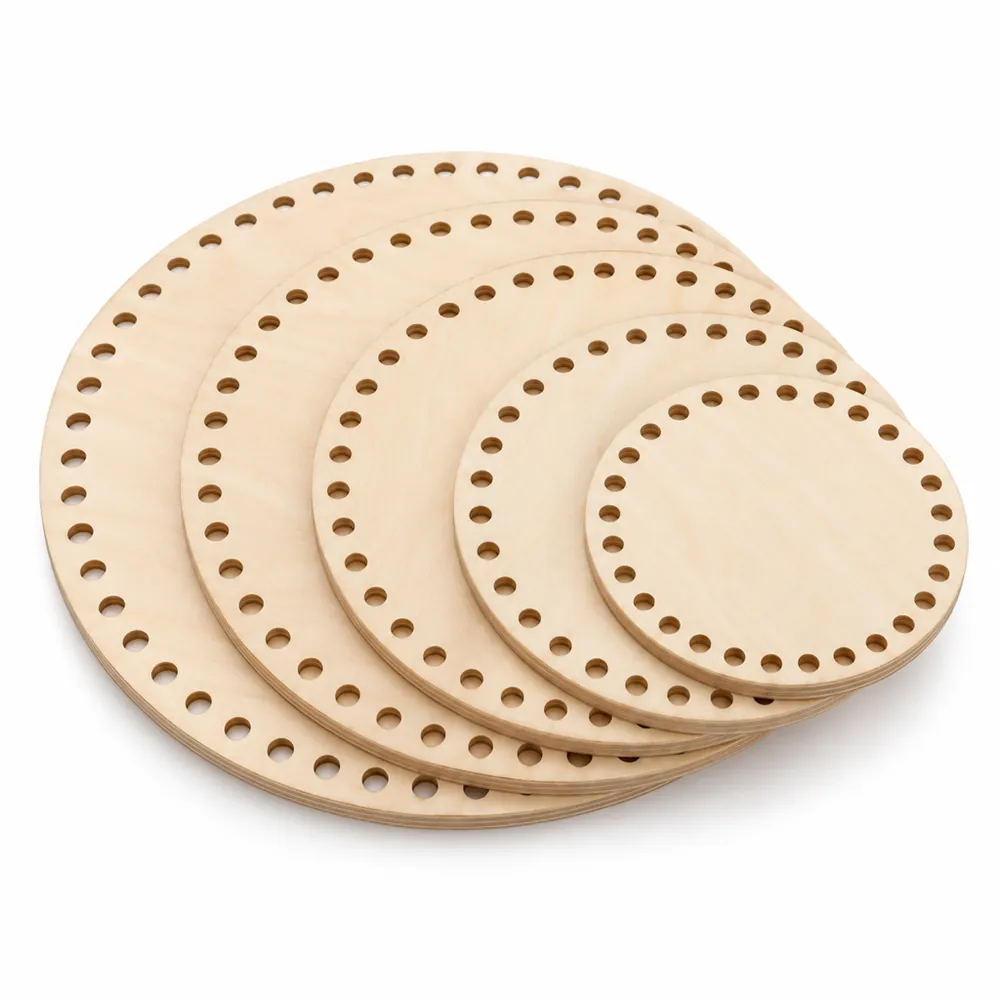
Photos illustrate the product type.
Wooden Basket Bases with Holes, Round, Sets of 5 or 12
Round plywood basket bases with a ring of pre-drilled stake holes, in sets of 5 (4 to 12 in) or 12 (6 to 12 in), for flat-bottomed reed baskets.
A wooden base takes the hardest part out of a first basket. Instead of weaving the bottom from reed, you start with a flat round plywood disc that already has a ring of drilled holes near the edge. Each hole holds one stake, so the stakes are evenly spaced from the start and the finished basket sits flat on the table.
These bases suit beginners making a first basket, teachers running a class where everyone needs to finish in one session, and makers who want sturdy, flat-bottomed baskets for bread, fruit, yarn or storage.
How a wooden base basket goes together:
- Soak the stake reed in warm water until it bends without cracking.
- Push one stake up through each hole, leaving a few inches below the base.
- Weave those short ends together underneath in a simple border, so the stakes cannot slip out. This also gives the basket a small foot.
- Turn the base over and weave the sides with thinner weavers, packing each row down.
- Finish with a border at the top, trim, and let the basket dry.
Count the holes before you start. With an odd number of stakes, a single weaver going over one and under the next works all the way round. With an even number, weave with two weavers that follow each other, or use twining.
The plywood can be stained or painted. Do it before you weave, so the color stays off the reed, and let it dry fully.
The 5-base set has one of each size, 4, 6, 8, 10 and 12 in, so you can try small and large baskets. The 12-base set has three each of 6, 8, 10 and 12 in, for classes, gifts and makers who like to repeat a favorite size.
How to choose
The base sets the size of the bottom. Sides that go straight up give a basket about as wide as its base; sides that flare out end up wider at the rim, so pick a base a little smaller than the top you want.
As a rough guide, 4 and 6 in bases make small gift baskets, ornaments and practice pieces; 8 and 10 in suit bread and fruit baskets and desk storage; 12 in is for larger storage and yarn baskets. For a first basket, a 6 or 8 in base is big enough to get a feel for the weave and small enough to finish without it dragging on.
Before you soak a whole batch, test one strand of your stake reed in a hole. Soaked reed should push through snugly without forcing.
Questions
What size reed fits the holes?
Use the heaviest round reed that pushes through a hole snugly when soaked, and test one strand before you soak a batch. Weavers are usually one or two sizes thinner than the stakes.
How long should I cut the stakes?
The height of the basket, plus several inches at the top for the border and a few inches below the base for the bottom border. Cut one, try it, then cut the rest to match.
Do I need an odd number of stakes?
Only for plain over-and-under weaving with one weaver. With an even number of holes, weave with two weavers at once or use twining, and the pattern still works.
Can I stain or paint the base?
Yes. Finish the plywood before you weave so the color stays off the reed, and let it dry fully before the wet reed goes in.
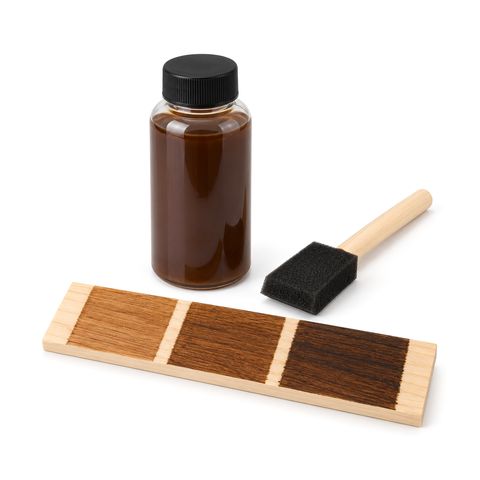 Water-Based Wood Stain for Chair Frames and Cane
You may also need
-
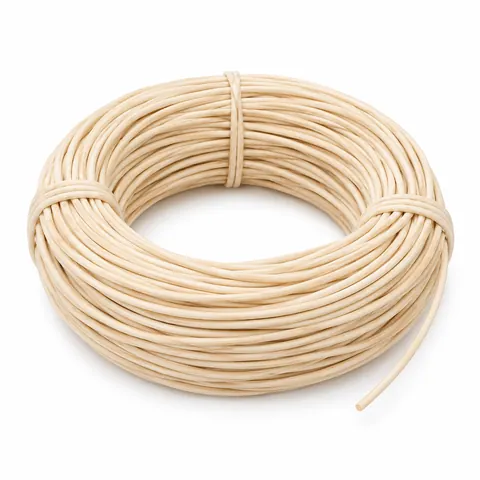
Round Reed for Basket Weaving, 1 lb Coil, #2 to #6
Natural round reed from the rattan core, 1 lb coils in #2 (1.75 mm) to #6 (3.75 mm), for basket stakes and weavers, wicker repair and spokes.
$25.99 · 5 options
-
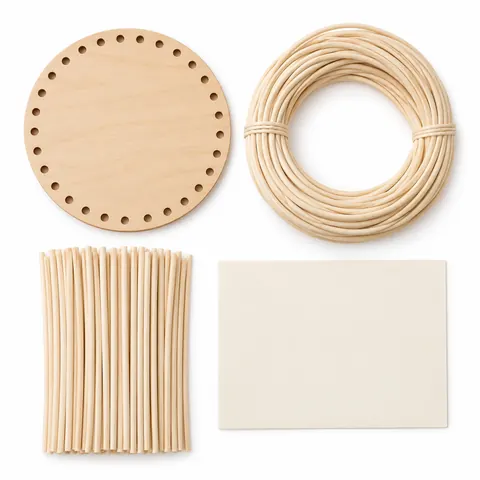
Basket Weaving Kit for Beginners with Wooden Base and Reed
Everything for one small round basket about 7 in across: a pre-drilled wooden base, natural round reed and a printed step-by-step card for a first basket.
$21.99
-
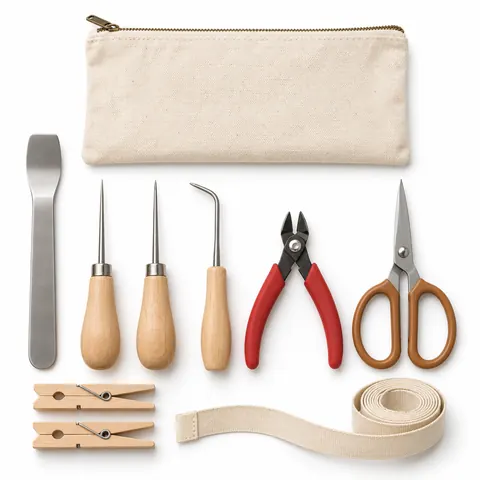
Basket Weaving Tool Kit, 20 Pieces, with Zip Pouch
A 20-piece basket weaving tool kit: packing tool, two awls, bent-tip bodkin, side cutters, small shears, clips, tape measure and pegs in a zip pouch.
$16.99